



Types of training based on tactics. Roles and responsibilities of each player
This is the most specific course of all, designed for competitive players. It doesn’t matter which category you compete in—what’s important is that you are a competitive player whose goal is to prepare and improve in order to raise your individual level in all aspects.
This is a highly tactical module where we delve deeply into the roles and responsibilities of the right-side and left-side players in modern padel, and above all, the characteristics, attitudes, and aptitudes they must have—not only to play on a specific side but to understand that side of the game and have the ability to execute its demands.
We study the importance of the three fundamental factors for competing: PHYSICAL, TACTICAL, AND MENTAL CAPACITY—all based on what we at IPA call the POWER OF TRAINING.
On court, this is a very demanding course, with 15 hours of training involving physical-technical and physical-tactical tasks, court situations, match situations, and analysis. If you compete, you’re going to enjoy it a lot!
Click on the video, and our Co-founder Dani Herrera will explain the objectives of this course in detail >>>>>>
These are the topics of the content that we will analyze in the course.
The Power of Training
It is the only path to achieving your goals. The first thing we analyze in this course is that YOU HAVE TO LEARN HOW TO TRAIN. It’s not about playing—it’s about focusing on the specific concept being trained.
Training should last 24 hours; it doesn’t start when you step onto the court nor end when you leave. The power of training achieves everything—if you give it your all.
The Demands of Competition in Padel
No matter which category you compete in—whether fourth or third—every player wants to be the best in their category and climb in level and ranking. All of this requires certain demands, and in this course, we explore each one.
Legs, Attitude, and Strokes
The stroke is the least important part—the most crucial are the legs. Without physical response, it’s impossible to maintain an excellent level of play.
In padel, the ball rhythm is continuous due to the court dimensions. To reach the ball in the best conditions, we need these three ingredients in that order.
Physical Preparation: Types of Training
We dedicate significant time to this fundamental aspect, exploring and analyzing the types of training adapted to padel. Each player needs to work on achieving balance and physical response: endurance, speed, strength, and power.
Physical capacity is indispensable in this sport and should be given even more importance than the padel-specific aspects. Your level will improve greatly with the technical and tactical resources you have if you possess physical response.
What Type of Player Do You Want to Be?
In the course, we perform a series of exercises so that students themselves can clarify what type of player they want to be. To do this, you must be honest with yourself and openly acknowledge what you do well and what you need to improve. Often, we want to do things we don’t know how to do.
SWOT Analysis for Each Player
This is a very useful tool for every player. Knowing your own WEAKNESSES, THREATS, STRENGTHS, and OPPORTUNITIES is fundamental for self-discovery.
The result is surprising because it clearly marks the path you should follow.
What Type of Player Can You Be?
The results from the SWOT analysis guide you toward understanding what type of player you can be. There may be things you don’t like, and those can be improved with training—but with clarity, we can start building a solid player based on doing what you do well as much as possible.
Roles and Responsibilities of the Right-Side Player
Modern padel has evolved the right-side player compared to 5 or 6 years ago. Today, the right-side player assumes the same—or even more—responsibilities as the left-side player.
In the course, we clarify all these points based on each player’s capabilities and profile, starting from the premise that it is much more difficult to play on the right side than the left, beginning with the space available to launch the ball.
Roles and Responsibilities of the Left-Side Player
The left-side player should, in principle, be the more explosive one—more physical and assuming greater responsibility—and this is largely true (as long as they are not playing with a left-hander). In this module, we analyze all the characteristics of players on this side and see that not everyone is suited to play there.
Types of Comprehensive On-Court Training
We present the different types of comprehensive training and provide a TRAINING GUIDE with clearly defined objectives to teach attending players how to train properly. We then implement all these exercises and tasks on court.
Generic Tactical Concepts in Padel Play
In padel, there are very basic and generalized plays that provide an initial foundation on paper—but it’s only a base that points the way. In reality, during a padel match, situations arise where you must adapt your game, and that’s where STRATEGY comes in.
We study these generic tactical concepts in the course.
Strategies Based on Opponent Analysis
On paper, everything seems quite simple and easy—the difficulty lies in EXECUTING IT, and that is called STRATEGY.
Many external elements come into play that make the player feel more comfortable: the court, the weather, the time of day, etc. Then there’s the reality of the game, which involves analyzing the opponents’ playing style—and that analysis guides the path. Executing it is what makes this game truly difficult. The player or pair that best adapts to all external and internal factors of the match has the greater chance of winning.
Offensive and Defensive Proposal Capacity
Based on self-analysis and team analysis with your partner, certain offensive and defensive proposals must be implemented. In the course, we analyze all types of proposals on paper and then execute them on court, emphasizing the ORDER and evaluating execution capacity.
The ORDER must be applied based on the player’s actual capabilities. You cannot ask for something they don’t know how to do, even if the player believes they can.
Capacity to Neutralize Opponents' Offensive and Defensive Proposals
Are we capable of hitting a good lob against a strong smasher? Are we capable of playing solidly low to avoid their power? Are we capable of returning a strong serve? Are we capable of maintaining volume under pressure?
Opponents propose, and the other side counters with their weapons—and vice versa. That’s what this sport is about: knowing, wanting, and being able.
On-Court Training Tasks Guide
Each player receives a guide of physical-tactical training tasks and game situations to perform on court.
This is the way to improve. Remember the POWER OF TRAINING.
Course Price
To inquire about the course price, you can do so by sending an email to info@padelacademy.com
Course Logistics
All organization planned down to the last detail in a practical, simple, and efficient way.

COURSE DURATION
The course takes place over 3 days: Friday, Saturday, and Sunday. Players are expected to arrive at 9:00 AM on Friday to receive the Welcome Pack.

SCHEDULE
The course runs from Friday at 9:00 AM until Sunday at 9:00 PM. The daily schedule is from 9:00 AM to 2:00 PM and from 4:00 PM to 9:00 PM.

THEORETICAL AND ANALYTICAL PART
On Friday, we have 5 hours of theory. On Saturday and Sunday, we dedicate 2 hours in the classroom to personalized analysis for each player.
de cada jugador.

PRACTICAL ON-COURT PART
21 hours on court to work on all the concepts analyzed. This part is highly organized to make the most of the training.

BREAK TIMES
We take a 20-minute break mid-morning for breakfast. After finishing the morning session, everyone has lunch together at the club.

COACHING STAFF
The training will feature the two IPA coaches: Dani Herrera and Álvaro Clemente. We will also have on-court support from local coaches trained by IPA.

WORKING GROUPS
We will work on court in groups of 4 players, always with the presence of our coaches to carry out the practical tasks of the course.

COURSE PRICE
The course price varies depending on the country where it is held. For each edition, we will inform you of the price per student, which includes the training and the Welcome Pack.
Welcome Pack
All players in the course will receive this material.
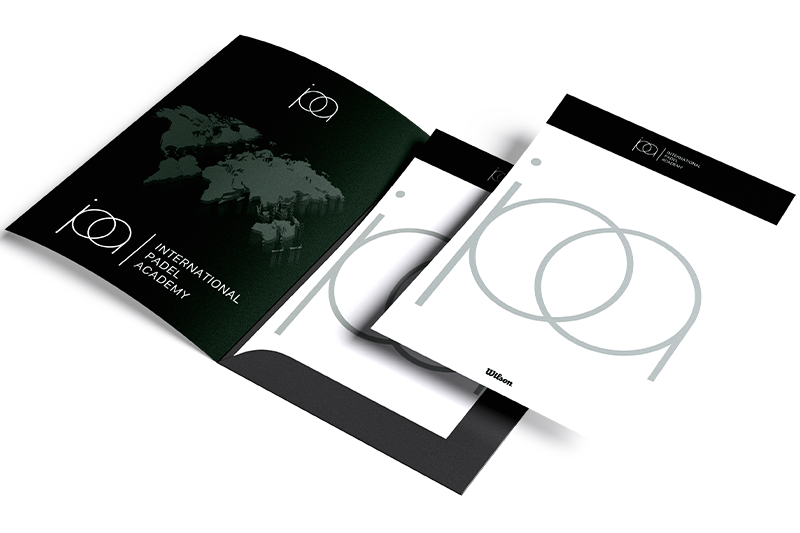
Each player will receive a course handbook with the full program development, a notepad, and a pen for the training sessions.
DIDACTIC MATERIAL
All players in the course will receive this material.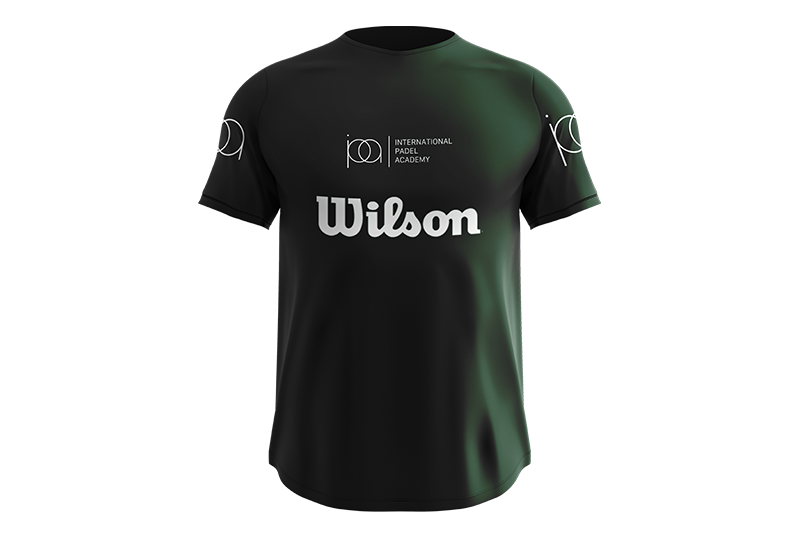
Course players will receive the official IPA hoodie.
COURSE EQUIPMENT
100% organic polyester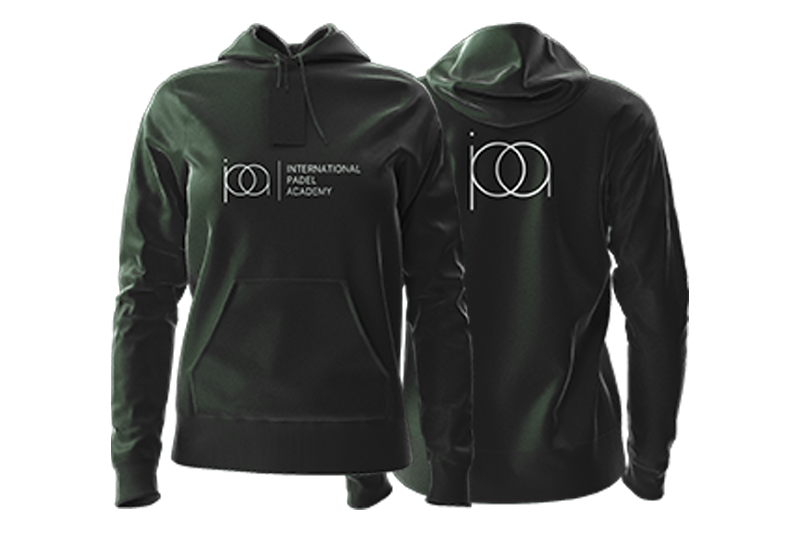
Course players will receive the official IPA hoodie.
OFFICIAL IPA HOODIE
100% organic cotton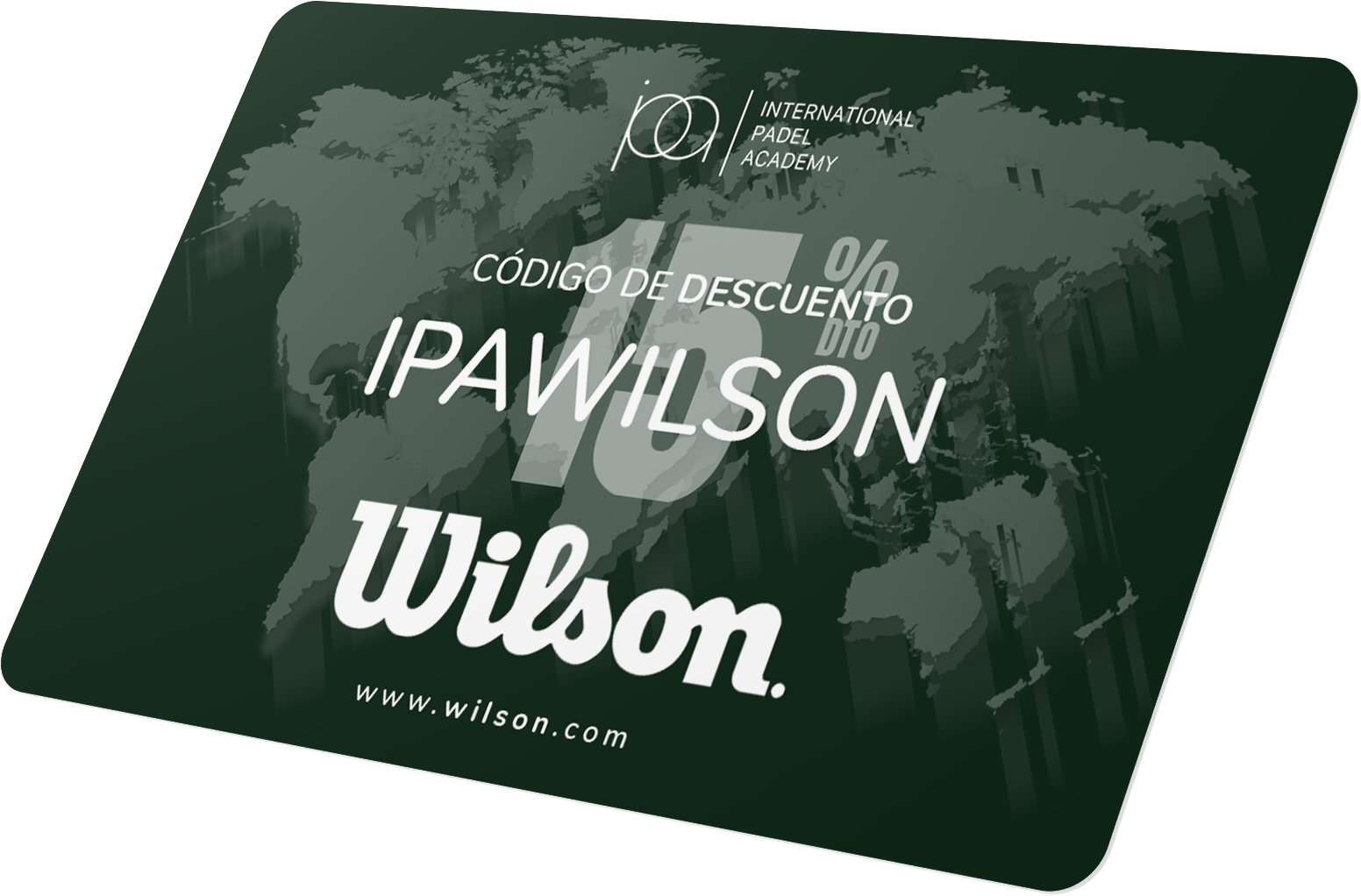
All registered participants will receive a card with a 12% discount on all products from our sponsor WILSON.
DISCOUNT CARD
www.wilson.comMODULE 3. COMPETITION TRAINING SYSTEMS
Types of training based on tactics. Roles and responsibilities of each player
This is the most specific course of all, designed for competitive players. It doesn’t matter which category you compete in—what’s important is that you are a competitive player whose goal is to prepare and improve in order to raise your individual level in all aspects.
This is a highly tactical module where we delve deeply into the roles and responsibilities of the right-side and left-side players in modern padel, and above all, the characteristics, attitudes, and aptitudes they must have—not only to play on a specific side but to understand that side of the game and have the ability to execute its demands.
We study the importance of the three fundamental factors for competing: PHYSICAL, TACTICAL, AND MENTAL CAPACITY—all based on what we at IPA call the POWER OF TRAINING.
On court, this is a very demanding course, with 15 hours of training involving physical-technical and physical-tactical tasks, court situations, match situations, and analysis. If you compete, you’re going to enjoy it a lot!
Click on the video, and our Co-founder Dani Herrera will explain the objectives of this course in detail >>>>>>
These are the topics of the content that we will analyze in the course.
The Power of Training
It is the only path to achieving your goals. The first thing we analyze in this course is that YOU HAVE TO LEARN HOW TO TRAIN. It’s not about playing—it’s about focusing on the specific concept being trained.
Training should last 24 hours; it doesn’t start when you step onto the court nor end when you leave. The power of training achieves everything—if you give it your all.
The Demands of Competition in Padel
No matter which category you compete in—whether fourth or third—every player wants to be the best in their category and climb in level and ranking. All of this requires certain demands, and in this course, we explore each one.
Legs, Attitude, and Strokes
The stroke is the least important part—the most crucial are the legs. Without physical response, it’s impossible to maintain an excellent level of play.
In padel, the ball rhythm is continuous due to the court dimensions. To reach the ball in the best conditions, we need these three ingredients in that order.
Physical Preparation: Types of Training
We dedicate significant time to this fundamental aspect, exploring and analyzing the types of training adapted to padel. Each player needs to work on achieving balance and physical response: endurance, speed, strength, and power.
Physical capacity is indispensable in this sport and should be given even more importance than the padel-specific aspects. Your level will improve greatly with the technical and tactical resources you have if you possess physical response.
What Type of Player Do You Want to Be?
In the course, we perform a series of exercises so that students themselves can clarify what type of player they want to be. To do this, you must be honest with yourself and openly acknowledge what you do well and what you need to improve. Often, we want to do things we don’t know how to do.
SWOT Analysis for Each Player
This is a very useful tool for every player. Knowing your own WEAKNESSES, THREATS, STRENGTHS, and OPPORTUNITIES is fundamental for self-discovery.
The result is surprising because it clearly marks the path you should follow.
What Type of Player Can You Be?
The results from the SWOT analysis guide you toward understanding what type of player you can be. There may be things you don’t like, and those can be improved with training—but with clarity, we can start building a solid player based on doing what you do well as much as possible.
Roles and Responsibilities of the Right-Side Player
Modern padel has evolved the right-side player compared to 5 or 6 years ago. Today, the right-side player assumes the same—or even more—responsibilities as the left-side player.
In the course, we clarify all these points based on each player’s capabilities and profile, starting from the premise that it is much more difficult to play on the right side than the left, beginning with the space available to launch the ball.
Roles and Responsibilities of the Left-Side Player
The left-side player should, in principle, be the more explosive one—more physical and assuming greater responsibility—and this is largely true (as long as they are not playing with a left-hander). In this module, we analyze all the characteristics of players on this side and see that not everyone is suited to play there.
Types of Comprehensive On-Court Training
We present the different types of comprehensive training and provide a TRAINING GUIDE with clearly defined objectives to teach attending players how to train properly. We then implement all these exercises and tasks on court.
Generic Tactical Concepts in Padel Play
In padel, there are very basic and generalized plays that provide an initial foundation on paper—but it’s only a base that points the way. In reality, during a padel match, situations arise where you must adapt your game, and that’s where STRATEGY comes in.
We study these generic tactical concepts in the course.
Strategies Based on Opponent Analysis
On paper, everything seems quite simple and easy—the difficulty lies in EXECUTING IT, and that is called STRATEGY.
Many external elements come into play that make the player feel more comfortable: the court, the weather, the time of day, etc. Then there’s the reality of the game, which involves analyzing the opponents’ playing style—and that analysis guides the path. Executing it is what makes this game truly difficult. The player or pair that best adapts to all external and internal factors of the match has the greater chance of winning.
Offensive and Defensive Proposal Capacity
Based on self-analysis and team analysis with your partner, certain offensive and defensive proposals must be implemented. In the course, we analyze all types of proposals on paper and then execute them on court, emphasizing the ORDER and evaluating execution capacity.
The ORDER must be applied based on the player’s actual capabilities. You cannot ask for something they don’t know how to do, even if the player believes they can.
Capacity to Neutralize Opponents' Offensive and Defensive Proposals
Are we capable of hitting a good lob against a strong smasher? Are we capable of playing solidly low to avoid their power? Are we capable of returning a strong serve? Are we capable of maintaining volume under pressure?
Opponents propose, and the other side counters with their weapons—and vice versa. That’s what this sport is about: knowing, wanting, and being able.
On-Court Training Tasks Guide
Each player receives a guide of physical-tactical training tasks and game situations to perform on court.
Course Price
To inquire about the course price, you can do so by sending an email to info@padelacademy.com
Course Logistics
All organization planned down to the last detail in a practical, simple, and efficient way.
COURSE DURATION
The course takes place over 3 days: Friday, Saturday, and Sunday. Players are expected to arrive at 9:00 AM on Friday to receive the Welcome Pack.
el Welcome Pack.
SCHEDULE
The course runs from Friday at 9:00 AM until Sunday at 9:00 PM. The daily schedule is from 9:00 AM to 2:00 PM and from 4:00 PM to 9:00 PM.
THEORETICAL AND ANALYTICAL PART
On Friday, we have 5 hours of theory. On Saturday and Sunday, we dedicate 2 hours in the classroom to personalized analysis for each player.
PRACTICAL ON-COURT PART
21 hours on court to work on all the concepts analyzed. This part is highly organized to make the most of the training.
BREAK TIMES
We take a 20-minute break mid-morning for breakfast. After finishing the morning session, everyone has lunch together at the club.
COACHING STAFF
The training will feature the two IPA coaches: Dani Herrera and Álvaro Clemente. We will also have on-court support from local coaches trained by IPA.
WORKING GROUPS
We will work on court in groups of 4 players, always with the presence of our coaches to carry out the practical tasks of the course.
COURSE PRICE
The course price varies depending on the country where it is held. For each edition, we will inform you of the price per student, which includes the training and the Welcome Pack.
Welcome Pack
All players in the course will receive this material.
Each player will receive a course handbook with the full program development, a notepad, and a pen for the training sessions.
DIDACTIC MATERIAL
All players in the course will receive this material.Course players will receive the official IPA hoodie.
COURSE EQUIPMENT
100% organic polyesterCourse players will receive the official IPA hoodie.
OFFICIAL IPA HOODIE
100% organic cottonAll registered participants will receive a card with a 12% discount on all products from our sponsor WILSON.
DISCOUNT CARD
www.wilson.comLegal Notice | Privacy Policy | Cookie Policy | Contact details

The IPA is managed by a company from Spain.
All rights are reserved for the company.

Follow us on our social networks

The official brand of the IPA.
Visit their www.wilson.com to get all their products.